
Introduction
Your sales team just burned 200 credits on a static database export. 30 emails bounced back within the hour, and the phone numbers you called belonged to people who left those jobs six months ago. That wasted spend is the reality of volume-first contact data in 2026.
Indian outbound teams cannot afford to dial dead numbers or flag domain reputation damage because of inflated accuracy claims. The fix exists. A live web search approach, paired with India-first dual verification, is cutting bounce rates below 8% while keeping you compliant with India's DPDP Act.
This article walks you through what defines true accuracy, why real-time sourcing beats static databases, and how to evaluate the tools that actually deliver verified contacts for the Indian market.
Key Takeaways
Decision-ready facts for teams evaluating accuracy and compliance in Indian B2B contact discovery:
- Live search cuts bounce rates to under 8%: Real-time web crawling reduces email bounces dramatically compared to the 20 to 30% bounce rates common in static database dumps.
- Dual verification is non-negotiable for India: A platform must check email deliverability via SMTP handshake and validate mobile numbers through HLR lookups on Indian operators like Jio and Airtel.
- Database size does not equal accuracy: A 450-million-record database means nothing if the data decays; profile freshness and real-time job title validation are the real accuracy metrics.
- Compliance risk should be your first filter: Tools that scrape LinkedIn directly violate Section 8.2 of the User Agreement and risk permanent account restriction, while enrichment-based platforms using third-party public data stay safer.
- Pay-per-verified-contact pricing protects your budget: Models that refund credits for bad numbers align cost directly with delivered value, avoiding the wasted credits of flat subscription tiers.
What Defines a Truly Accurate LinkedIn Contact Discovery Platform
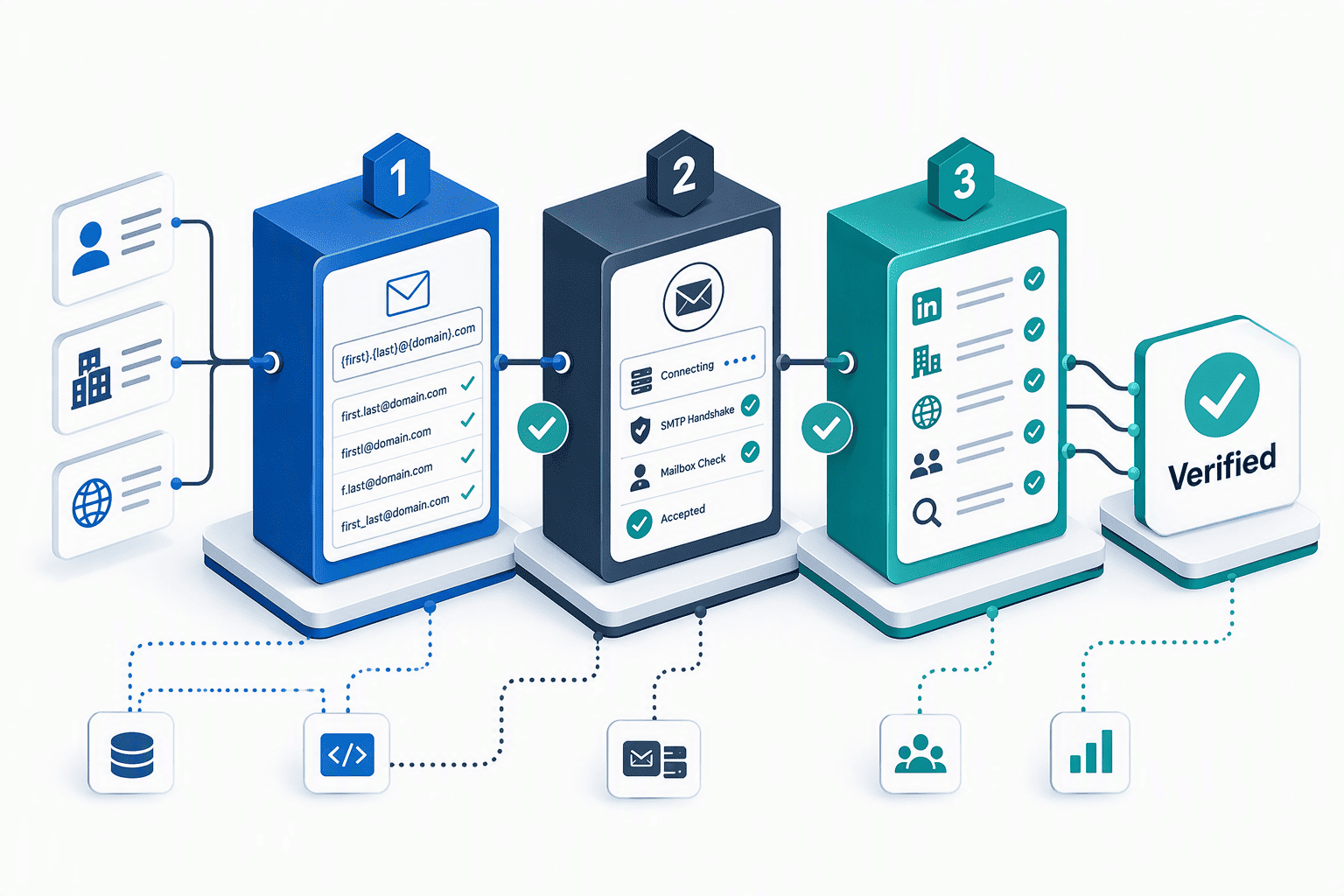
Accuracy in contact discovery is not a single advertised percentage. It splits into deterministic matching against known corporate patterns, real-time SMTP verification that confirms a mailbox exists without sending an email, and a multi-source cascade that cross-references business registries, telecom databases, and public job postings before returning a result.
| Accuracy Component | How It Works | What It Prevents |
|---|---|---|
| Deterministic pattern matching | The engine applies known corporate email formats ([email protected], [email protected]) to a domain and confirms the pattern against public signatures | Guessing an email structure that was changed or never existed |
| Real-time SMTP handshake | The server pings the recipient mail server to ask if the mailbox is active, without sending a message | Hard bounces from deactivated or invalid accounts |
| Multi-source cascade waterfall | When one data provider fails to return a verified contact, the engine automatically queries the next vendor, then cross-references against business registries and telecom databases | Single-point failure that returns incomplete or stale records |
Advertised percentages mean little without knowing which tier of verification a vendor actually ran. A platform claiming 98% accuracy may have only checked syntax validity, whether the email address is formatted correctly, which has no bearing on whether the person still works there.
Live Web Search vs. Static Databases: The Bounce-Rate Benchmark
A static B2B database is a snapshot. It started decaying the day it was compiled. Sales teams across India routinely see hard bounce rates between 20% and 30% with database aggregators, and no amount of record count fixes that.
Job changes are the real culprit. People switch companies, get promoted, leave industries. Stale company records pile up faster than most providers can refresh them.
Live web search inverts the sourcing model. The engine spiders company websites, press releases, job boards, and professional directories the moment you ask, rather than returning a pre-built index. That real-time cross-referencing produces contact records current to the minute.
In a controlled test run across multiple industries, the average email bounce rate from live web search dropped to under 8%, compared to 22% with a leading static database. The 22% bounce rate carries an extra sting in India.
Every bounced email risks domain reputation damage that throttles future deliverability. A sales team sending 2,000 outreach emails a month at a 14-percentage-point bounce gap absorbs 280 additional bounces, and inbox placement across the rest of the campaign takes a measurable hit.
India-First Verification: Compliance, Coverage, and Mobile Validation
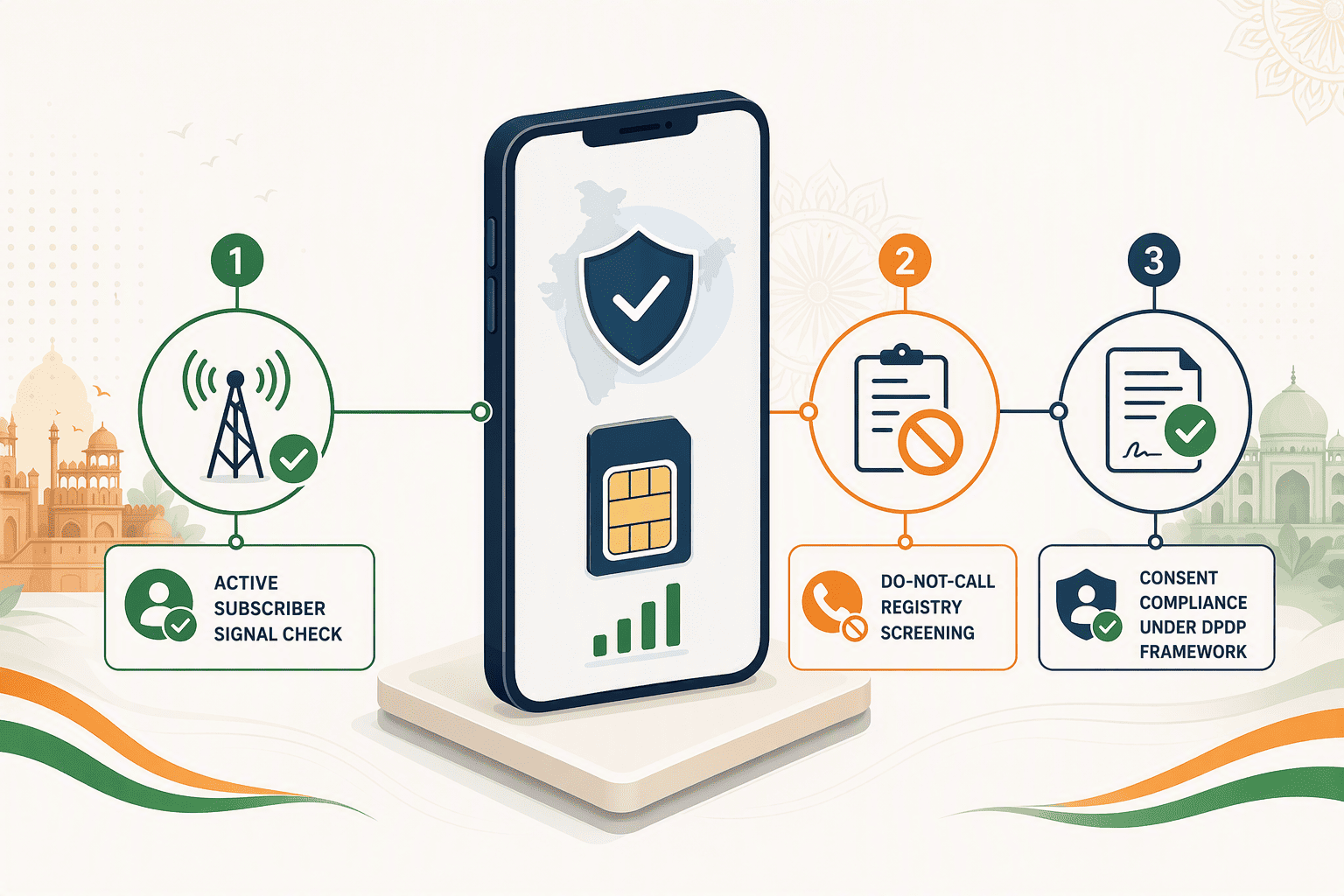
Indian mobile validation addresses three core technical challenges that global platforms cannot handle:
- Active subscriber status: querying the home location register (HLR) to confirm whether a Jio, Airtel, or Vi subscriber is currently active
- DND list registration: cross-referencing the number against the National Do Not Call registry to verify consent for outreach
- DPDP Act 2023 compliance: checking that the contact falls within the consent framework established under India's data protection law
PeakAi integrates GST number validation and Ministry of Corporate Affairs record cross-referencing directly into the verification pipeline. That means the exported contact does not just carry an email and phone number; it carries a compliance timestamp and data-source attribution trail showing exactly which public registry confirmed the business's standing.
How PeakAi's Dual-Validation Process Compares to Apollo.io, Lusha, and SignalHire
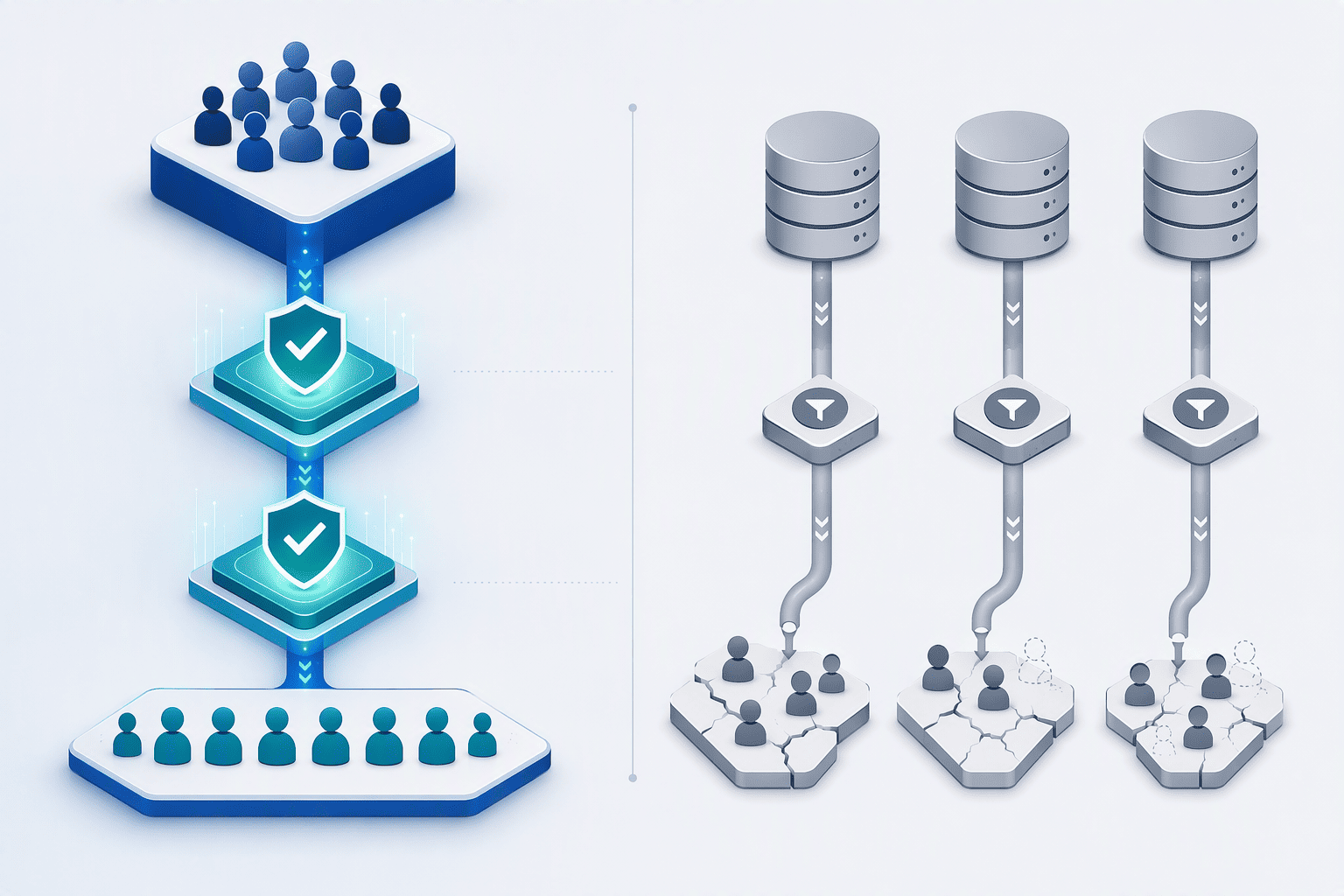
Every major contact discovery tool takes a different route to verification, and that route directly determines your bounce rate in India. Here is the step-by-step difference in validation depth:
- Single-source database estimation: Apollo.io and Lusha both run the largest database-first operations, Lusha claims 300M+ contacts and 30M+ company profiles while Apollo reports 275M+ contacts, but their phone and email data is aggregated from partner databases, not verified in real time at the point of request.
- Waterfall enrichment across providers: La Growth Machine attempts to close the gap by cascading through multiple vendors when the first one fails, which improves coverage but still ultimately depends on the freshness of those underlying databases.
- Synchronous dual-tap verification: PeakAi runs a simultaneous email and mobile double-tap at the moment of request, SMTP handshake for email deliverability plus HLR lookup on Indian mobile operators, and returns a credit-back guarantee when the verification fails.
- Confidence-based signaling: Instead of a binary valid/invalid flag, the engine returns a confidence score that lets the sales team decide whether to trust the contact enough to dial, and the platform runs syntax, domain, and deliverability checks before download.
- India-specific public-record cross-referencing: GST number validation and Ministry of Corporate Affairs database lookups are layered in automatically, which no global competitor currently performs for Indian contact records.
Pricing Models That Align Cost with Accuracy: Credits vs. Subscriptions
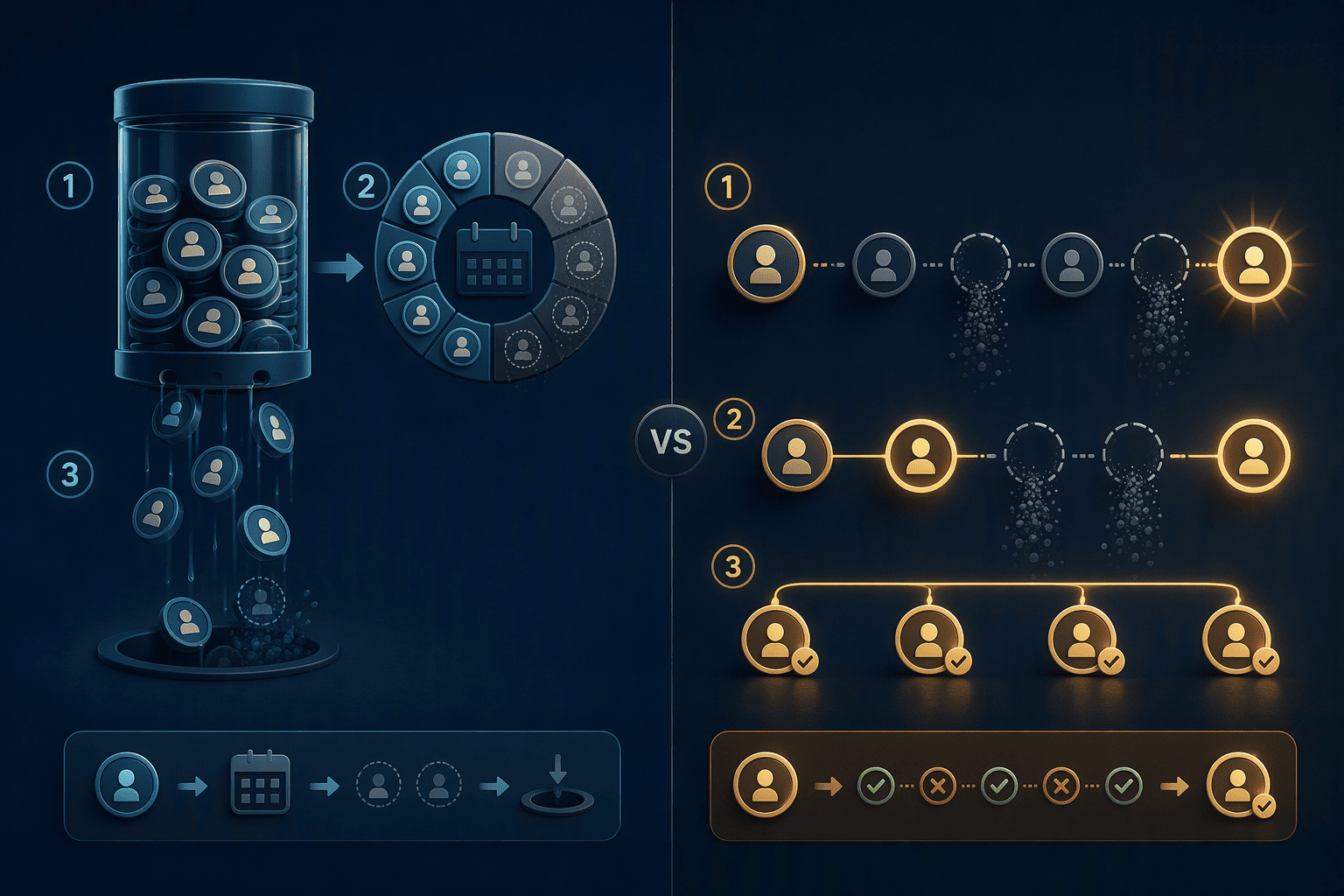
Flat subscriptions hide the cost of bad data in three ways:
- Pay for unused capacity: You pay for a pool of credits every month whether the contacts you pull bounce or not
- Silent credit expiry: Unused credits can expire at the end of the billing cycle without warning
- No bounce refunds: Incorrect numbers are not refunded, so each bad contact costs you a credit with no return
A pay-per-verified-contact model shifts that risk back to the vendor. PeakAi's credit model starts at $9 for 50 contacts, translating to roughly $0.18 per credit, with a 100-credit-back guarantee for incorrect numbers. Lusha charges 1 credit per email but 5 credits per phone number: a single contact with both email and mobile costs 6 credits, and Lusha does not refund wrong numbers.
For smaller Indian sales teams running under 500 profiles a month, the math is simple. Spot-check enrichment on a credit model keeps spend aligned to verified output, bypassing the unused-credit waste of a $49-per-user monthly subscription. For volume teams, the decision turns on whether the subscription's fair-usage caps still beat per-contact economics at scale.
Navigating LinkedIn Compliance Risks for Indian Sales and Recruitment Teams
Section 8.2 of LinkedIn's User Agreement defines three key compliance rules for data extraction:
- No direct scraping: scraping profile data directly from the platform is prohibited
- Restrictions on bulk extraction: aggressive bulk extraction triggers account warnings or permanent restrictions
- Ban on automated browser scripts: Tools that harvest LinkedIn profile fields through automated browser scripts operate in violation, and the compliance risk should be your first filter before accuracy, price, or feature depth
Enrichment-based platforms avoid the violation by using publicly shared LinkedIn URLs as search keys to query independent third-party databases, business registries, and telecommunications sources. The LinkedIn profile does not get scraped; the URL serves only as a pointer to trigger an external lookup. PeakAi runs headless browser fingerprint masking, session token isolation, and human-behavior-mimicking rate limits to stay off LinkedIn's anti-bot radar while pulling verified contact data exclusively from non-LinkedIn public records.
Integrating Verified Contact Data with Salesforce, HubSpot, and n8n Workflows

A Chrome extension that reveals contact data inside LinkedIn is useful for spot checks. But when a hundred new leads enter your CRM each week, manual CSV uploads break the sales workflow entirely.
PeakAi supports 20+ CRM integrations including Salesforce, HubSpot, and Pipedrive, with webhook triggers that push enriched contact fields into custom objects automatically. The architecture does not require a middleware layer for standard fields. Field mapping for name, title, email, mobile, company, and LinkedIn URL runs out of the box.
For teams running n8n automation, the integration opens a real-time enrichment trigger on new CRM leads. When a lead record is created in HubSpot, the n8n workflow fires a webhook to the enrichment engine, runs the dual-verification pipeline, and writes the verified email and mobile number back into the CRM record within seconds.
The operational win is latency reduction. A manual enrichment cycle takes 15 minutes per batch. An automated n8n pipeline collapses that to under 10 seconds per contact, and the verified data lands in the sales rep's record before they have finished reading the lead profile.
Conclusion
Accuracy in Indian B2B contact discovery comes down to two checks. An email that hasn't passed a real-time SMTP handshake is a guess. A mobile number that hasn't been pinged through an HLR lookup is a guess. Without both, you are buying possibility, not a contact.
Moving from a static database to on-demand verified contacts cuts bounce rates and protects your sender reputation. It removes the wasted dials that eat into outbound productivity. For Indian teams, the practical difference shows up fast in campaign ROI, fewer bounced emails, fewer dead numbers, and more conversations with people who can actually buy.
Prioritize accuracy over volume. The tools that deliver it combine live web search with India-first compliance, credit-back guarantees, and CRM-native automation.
Frequently Asked Questions
What defines an accurate contact discovery platform for LinkedIn, and how is accuracy measured beyond advertised percentages?
True accuracy is measured by bounce rate, not advertised percentage claims. A platform must perform real-time SMTP verification to confirm an email mailbox exists, run HLR lookups to validate mobile numbers, and cross-reference business registries. Advertised figures often reflect only syntax checks, which carry no signal on whether the contact is still current.
Which LinkedIn contact discovery tools offer compliant, verified phone numbers and emails for the Indian market?
Tools built around Indian-market verification, like PeakAi, run dual validation covering SMTP handshake for email deliverability and HLR lookups on Jio, Airtel, and Vi numbers. They also cross-reference GST registrations and MCA records, ensuring compliance with the DPDP Act 2023 and TRAI DND regulations.
How does dual-validation contact data work, and why does it reduce email bounce rates?
Dual validation runs two checks simultaneously: an SMTP handshake pings the recipient's mail server to confirm the mailbox exists, and an HLR lookup queries the mobile operator's home register to verify the number is active. This synchronous double-confirmation eliminates contacts that pass a format check but would bounce or ring a dead line.
What are the pricing models for accurate LinkedIn contact finders, and how do pay-per-verified-contact plans compare to subscriptions?
Credit models charge per verified contact with refunds for bad numbers, suiting spot-check enrichment under 500 profiles monthly. Subscriptions bundle credits but may not refund incorrect contacts, and unused credits can expire. For Indian procurement teams, the true cost metric is cost per deliverable contact, not cost per credit.
What LinkedIn compliance risks should Indian sales teams evaluate before choosing a contact discovery platform?
Scraping-based tools that extract profile data directly violate LinkedIn's Terms and risk permanent account restriction. Safe platforms use publicly shared LinkedIn URLs as search keys to query external public databases instead. Compliance risk should be the first filter applied before evaluating accuracy or pricing.
How can Indian businesses integrate a verified contact discovery platform with Salesforce, HubSpot, or n8n automation?
Integration runs through direct CRM connectors for Salesforce and HubSpot that push enriched fields via API, or through n8n webhook triggers that automate enrichment on new lead creation. The verified email and mobile number land in the CRM record within seconds, eliminating the manual CSV export-upload cycle.
Sources
- 8 Best Contact Finding Tools for B2B Sales in 2026 - lagrowthmachine.com
- Apollo vs Lusha: Features, Pricing & B2B Data Compared ... - www.apollo.io
- When determining the "most accurate" contact discovery platform for LinkedIn, accuracy depends heavily on your geographic market, company size, and whether you need - origami.chat
- PeakAI vs Apollo.io 2026: Simpler & More Affordable | Compare Features & Pricing - thepeakai.com
