
A 30% bounce rate in LinkedIn prospecting campaigns signals systematic contact data failure, where nearly one-third of outreach attempts land in invalid inboxes, triggering sender reputation damage and wasted effort.
Key Takeaways
- A 30% bounce rate in LinkedIn prospecting indicates that contact data has decayed, targeting is misaligned with your ideal customer profile, or enrichment sources violate LinkedIn's Terms of Service—all of which are fixable through systematic verification and compliance audits.
- Contact data decays at roughly 3% per month, meaning a six-month-old list is already 18% stale before your first message goes out [1].
- Only 5–10% of LinkedIn users share phone numbers with first-degree connections, and less than 1% share with second- or third-degree connections, making off-platform enrichment key.
- Real-time verification systems that cross-reference multiple data sources achieve 91% phone number accuracy, compared to static databases that struggle to exceed 80% [2].
- LinkedIn's Terms of Service explicitly prohibit automated scraping, putting prospecting teams at risk of permanent account suspension if their enrichment providers crawl LinkedIn directly.
What a 30% Bounce Rate Actually Means (And Why It's Fixable)
A 30% bounce rate in LinkedIn prospecting indicates that contact data has decayed, targeting is misaligned with your ideal customer profile, or enrichment sources violate LinkedIn's Terms of Service—all of which are fixable through systematic verification and compliance audits. When nearly one-third of your outreach attempts hit invalid inboxes, you're not just losing conversations—you're damaging your sender reputation and training email providers to treat your domain as a spammer. 2026 analysis, bounce rates over 5% trigger throttling, and anything around 10% results in effective blacklisting [3].
Bounce rates measure three distinct failure modes: invalid email addresses that never existed, outdated contacts where the person has changed roles or companies, and compliance blocks where LinkedIn or email providers flag your account for policy violations. Each requires a different fix. Invalid emails point to poor enrichment quality at the source. Outdated contacts signal that your refresh cycle hasn't kept pace with natural job-change rates, which average 15–20% annually in B2B markets [4]. Compliance blocks mean your data provider is scraping LinkedIn directly, violating the platform's terms and putting your account at risk.
The Hidden Cost of High Bounce Rates
Most teams focus on the lost opportunity, 30% of your list never seeing your message. The bigger damage is cumulative. Email service providers track your domain's bounce rate across all campaigns. A single campaign with a 30% bounce rate can throttle your deliverability for weeks, affecting not just prospecting but customer success emails, renewal reminders, and even internal communications tied to that domain. According to a 2026 audit of B2B prospecting databases, companies with bounce rates exceeding 20% saw 40 to 60% reductions in overall email deliverability within 90 days [4].
The Five Root Causes of LinkedIn Prospecting Bounce Rates
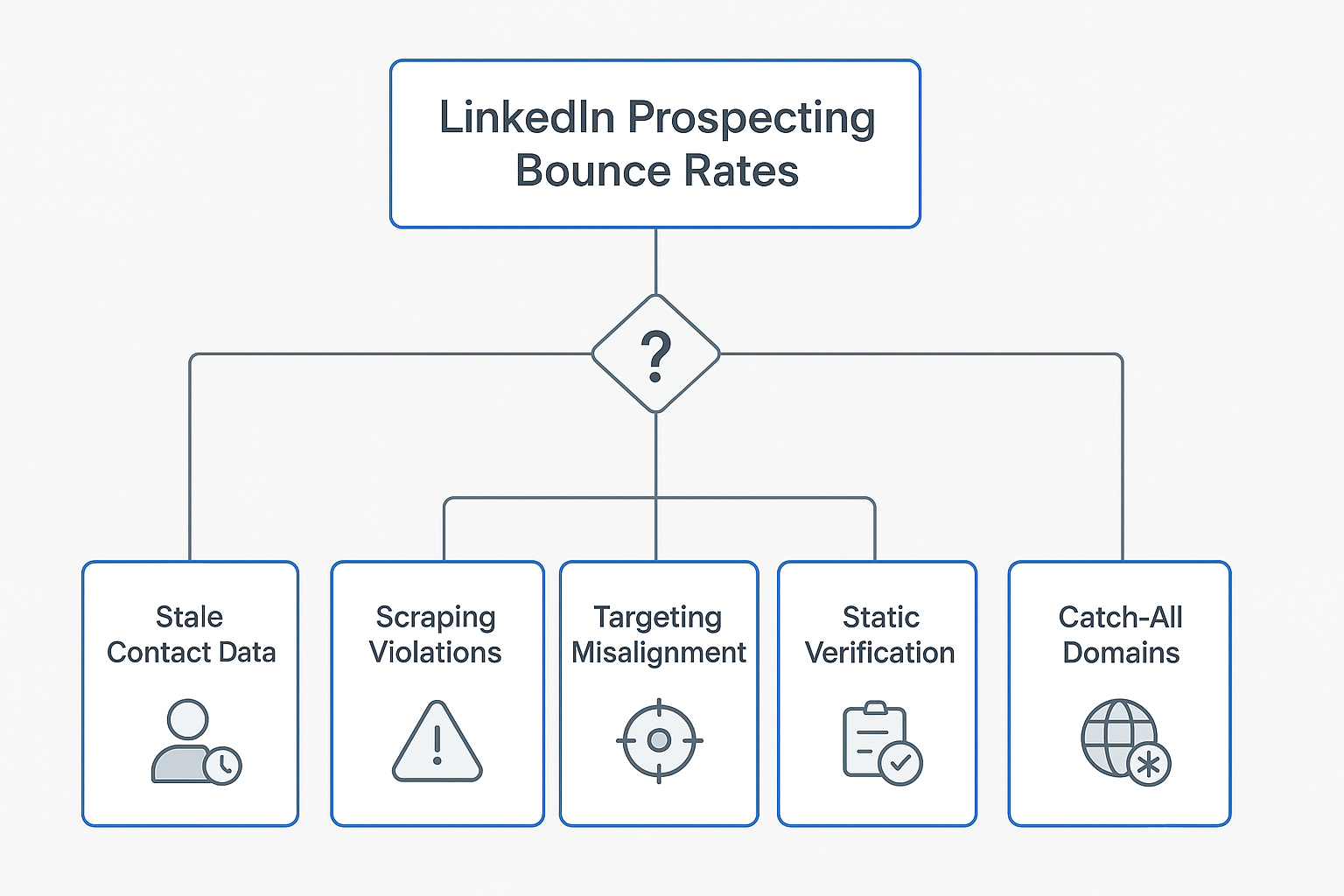
LinkedIn prospecting bounce rates stem from five identifiable root causes: stale contact data, scraping-based enrichment providers that violate compliance standards, misaligned targeting logic, CRM hygiene failures, and static verification methods that can't differentiate valid emails from catch-all domains.
Stale Contact Data and Natural Decay
B2B contact data decays at roughly 3% per month2026 analysis [1]. A six-month-old list is already 18% stale before your first outreach attempt. Job changes, company acquisitions, and IT infrastructure updates all contribute to this natural decay. Independent testing shows most providers deliver only about 50% accuracy on average [1], meaning half of your enriched contacts were already outdated when you downloaded them.
Scraping-Based Providers and Compliance Risk
LinkedIn's Terms of Service explicitly prohibit automated scraping. Platforms that crawl LinkedIn profiles directly, harvest contact data through bots, or circumvent rate limits violate these terms and expose users to permanent account suspension. Many enrichment tools market LinkedIn integration but operate by scraping public profiles, a practice that LinkedIn actively monitors and blocks. When your enrichment provider gets flagged, your account gets flagged too.
Targeting Misalignment: ICP Fit vs. Contact Availability
Teams often confuse LinkedIn profile visibility with contact availability. Just because a prospect matches your ideal customer profile on LinkedIn doesn't mean their work email is discoverable. Only 5 to 10% of LinkedIn users share phone numbers with first-degree connections, and enrichment tools that rely solely on LinkedIn's visible profile fields cannot fill in missing contact data. The gap between a perfect ICP match and a valid email address is where most bounce rates originate.
CRM Hygiene and Duplicate Records
CRMs accumulate duplicate records, outdated job titles, and contacts who no longer work at the listed company. A 2026 audit found that 43% of contacts in B2B prospecting databases had outdated job titles, 18% no longer worked at the listed company, and 27% were in roles without purchasing authority. When your CRM feeds into LinkedIn prospecting workflows, these hygiene failures compound, sending messages to people who left the company months ago.
Static Verification Methods and Catch-All Domains
Most third-party verification tools use SMTP tickling, which asks an email service if an email exists [5]. This method cannot differentiate between valid and invalid emails from a catch-all domain. A catch-all domain accepts all incoming mail, so SMTP tickling returns a positive result even if the specific email address routes to a default inbox that no one monitors. Apollo's 7-step verification process achieves 97% email accuracy by combining SMTP tickling with a data contributory network that tracks whether an email has sent or received traffic [5].
How to Diagnose Your Bounce Rate Problem in 4 Steps
Diagnosing a 30% bounce rate requires segmenting failures by type, auditing data sources for compliance violations, testing verification methods, and mapping bounce symptoms to specific contact attributes.
Step 1: Segment Bounces by Failure Type
Email service providers return different bounce codes for different failure modes. Hard bounces (invalid address, domain doesn't exist) point to enrichment quality issues. Soft bounces (mailbox full, temporary server error) suggest timing or deliverability problems. Compliance blocks (recipient marked as spam, sender domain flagged) indicate sender reputation damage. Export your bounce log from your email sequencer and categorize each bounce by code. If hard bounces exceed 10%, your enrichment source is unreliable. If compliance blocks exceed 2%, your domain is already flagged.
Step 2: Audit Data Sources for Scraping-Based Tools
Review every tool in your prospecting stack and ask: does this provider crawl LinkedIn directly? Generic tools that scrape LinkedIn directly violate platform Terms of Service and risk account bans. Check the provider's documentation for phrases like "LinkedIn scraping," "profile harvesting," or "automated data collection." If the tool requires you to log in to LinkedIn through their interface, it's likely using your credentials to scrape on your behalf, putting your account at risk. Compliant providers source data through legitimate business databases and public records [6].
Step 3: Test Verification Methods Against Catch-All Domains
Identify 10 contacts from your list whose domains are catch-all (most.edu domains and many enterprise domains are catch-all). Run those emails through your current verification tool. If the tool marks them all as valid without any risk flags, it's relying solely on SMTP tickling and cannot differentiate real inboxes from default catch-all routes. Tools that layer SMTP verification with send/receive activity tracking, such as those that verify whether an email has participated in recent email exchanges, achieve significantly higher accuracy on catch-all domains [5].
Step 4: Map Bounce Symptoms to Contact Attributes
Cross-reference your bounce log with contact attributes: company size, industry, seniority level, data source, and enrichment date. If bounces cluster in one segment, say, contacts enriched more than 90 days ago, or contacts from a specific data provider, you've identified a root cause. This segmentation reveals whether the problem is universal (your entire enrichment stack is broken) or localized (one provider, one industry vertical, or one age cohort).
Fix #1: Replace Stale Contact Data With Real-Time Verification
Real-time verification systems cross-reference multiple data sources beyond LinkedIn's visible profile fields, achieving 91% phone number accuracy and delivering results in 10 seconds [2]. Static databases, by contrast, struggle to exceed 80% phone verification because they rely on outdated snapshots that don't account for job changes or IT infrastructure updates [7].
The difference between static and real-time verification lies in the data sources. Static databases pull from fixed repositories that update quarterly or annually. Real-time systems query live public records, business registries, and contributory networks where millions of linked mailboxes confirm whether an email has sent or received traffic recently. This layered approach is what allows platforms to differentiate valid emails from catch-all domains, a capability that SMTP-only verification tools cannot provide.
PeakAi delivers real-time LinkedIn enrichment with 91% phone number accuracy and 10-second verification speed. The platform cross-references multiple data sources beyond LinkedIn's visible profile fields to achieve this accuracy. For teams that want verified email and phone discovery tied to LinkedIn-native prospecting and CRM sync, the Chrome-extension workflow integrates directly into existing prospecting processes.
Establish a 90-day re-verification cycle for all contacts, regardless of source. Contact data decay accelerates in high-turnover industries like technology and professional services, where annual job-change rates exceed 20%. A quarterly refresh keeps your list aligned with real-world mobility patterns and prevents the gradual accumulation of stale records that eventually push bounce rates into the danger zone.
Fix #2: Audit Your Data Sources for Compliance Risk
LinkedIn's Terms of Service explicitly prohibit automated scraping, and platforms that crawl LinkedIn profiles directly expose users to permanent account suspension. Compliance audits should verify that enrichment providers source data through legitimate business databases and public records rather than bot-based harvesting.
Ask your enrichment provider three questions: Where does your data come from? Do you scrape LinkedIn directly? What happens to my LinkedIn account if your service gets flagged? Evasive answers or marketing language about "LinkedIn integration" without technical detail are red flags. Compliant providers will explicitly state that they do not scrape LinkedIn and will document their use of public business registries, opt-in panels, and third-party data partnerships.
India's Digital Personal Data Protection Act, which came into force in November 2025, introduces new compliance obligations for data fiduciaries, with full enforcement beginning in May 2027 [8]. Teams operating in or targeting India must verify that their data providers comply with consent, purpose limitation, and data minimization requirements under the DPDP Act. Non-compliance can result in penalties and reputational damage in a market where data privacy enforcement is accelerating.
Fix #3: Rebuild Targeting Logic to Match ICP Signals
Targeting misalignment occurs when LinkedIn profile filters identify the right people but enrichment tools cannot deliver valid contact data for those profiles. Only 5 to 10% of LinkedIn users share phone numbers with first-degree connections, so off-platform enrichment is key, but not all enrichment sources cover all segments equally.
Rebuild your ICP filters to prioritize contact availability alongside role and company fit. If your enrichment provider has stronger coverage in North America than EMEA, adjust your LinkedIn search geography to match. If phone number accuracy drops for contacts at companies under 50 employees, tighten your company size filter. The goal is to align your targeting criteria with segments where your enrichment stack delivers verified data consistently.
Test enrichment quality by segment before launching full campaigns. Pull 100 contacts from each key segment (industry, geography, seniority) and run them through your enrichment and verification stack. Measure email validity, phone number availability, and job title accuracy. Segments with sub-80% validity should be excluded or re-sourced through a different provider. This segmented testing prevents you from burning your sender reputation on unverified cohorts.
Measuring Improvement: KPIs to Track Post-Fix
After implementing fixes, track four KPIs weekly: hard bounce rate, soft bounce rate, email open rate, and response rate. Hard bounce rate should drop below 2% within 30 days if you've switched to real-time verification [3]. Soft bounce rate fluctuates but should remain under 5%. Open rates and response rates are lagging indicators, they improve only after your sender reputation recovers, which can take 60 to 90 days.
Set up weekly reports that segment bounce rates by contact source, enrichment date, and industry. This ongoing monitoring catches new decay patterns before they compound into another bounce rate crisis. If a specific data source starts showing elevated bounces, pause campaigns from that source immediately and re-verify the affected cohort before resuming outreach.
| KPI | Target Threshold | Tracking Cadence | What It Signals |
|---|---|---|---|
| Hard Bounce Rate | < 2% | Weekly | Enrichment quality and verification accuracy |
| Soft Bounce Rate | < 5% | Weekly | Timing, deliverability, and temporary server issues |
| Compliance Blocks | < 1% | Weekly | Sender reputation and domain health |
| Email Open Rate | > 20% | Bi-weekly | Sender reputation recovery and subject line relevance |
| Response Rate | > 5% | Bi-weekly | Targeting accuracy and message relevance |
Run A/B tests on verification methods by splitting your list into cohorts and enriching each cohort through a different provider. Compare bounce rates, response rates, and cost-per-verified-contact across providers. This empirical testing reveals which enrichment stack delivers the best ROI for your specific ICP and geography, rather than relying on vendor claims or industry benchmarks that may not apply to your market.
Conclusion
A 30% bounce rate is not a messaging problem or a LinkedIn algorithm problem, it's a data quality and compliance problem. The fix requires switching from static databases to real-time verification, auditing enrichment providers for scraping-based tools that violate LinkedIn's Terms of Service, and aligning targeting logic with contact availability rather than profile fit alone. Teams that implement these three fixes see bounce rates drop below 5% within 60 days and sender reputation recover within 90 days, unlocking the prospecting performance that clean data and compliant workflows deliver. The choice is between continuing to burn sender reputation on stale lists or investing in verification infrastructure that compounds in value with every campaign. Start by auditing your current enrichment stack against the compliance checklist in Fix #2, then test real-time verification on a 100-contact cohort to measure improvement before scaling.
Frequently Asked Questions
Why are my LinkedIn prospecting efforts failing with 30% bounce rates?
A 30% bounce rate indicates that contact data has decayed, targeting is misaligned, or enrichment sources violate LinkedIn's Terms of Service. Contact data decays at roughly 3% per month [1], and most providers deliver only about 50% accuracy on average. Real-time verification systems that cross-reference multiple data sources achieve 91% phone number accuracy [2], fixing the root causes systematically.
How often should I re-verify contact data to prevent bounce rate spikes?
Re-verify all contacts every 90 days to account for natural decay rates of 2 to 3% per month. High-turnover industries like technology see annual job-change rates exceeding 20%, which accelerates contact decay. Quarterly re-verification prevents the gradual accumulation of stale records that push bounce rates into the danger zone and damage sender reputation over time.
What is the difference between real-time verification and static database lookups?
Real-time verification cross-references live public records, business registries, and contributory networks to deliver 91% phone number accuracy in 10 seconds [2]. Static databases rely on outdated snapshots that update quarterly or annually, struggling to exceed 80% accuracy because they cannot account for job changes or IT infrastructure updates that occur between refresh cycles [7].
How do I know if my enrichment provider is scraping LinkedIn directly?
Ask three questions: Where does your data come from? Do you scrape LinkedIn directly? What happens to my account if your service gets flagged? Evasive answers or vague claims about "LinkedIn integration" are red flags. Compliant providers explicitly state they source data through legitimate business databases and public records, not bot-based harvesting.
What bounce rate threshold triggers email deliverability problems?
Bounce rates under 2% are safe and go unnoticed by email service providers. Rates over 5% trigger throttling, slowing your sequences to a crawl. Rates around 10% result in effective blacklisting, where recovery takes weeks and affects all emails tied to your domain, including customer success and renewal reminders [3].
Best affordable contact enrichment tools for Indian B2B market?
Tools that combine real-time verification, CRM integration, and India-focused coverage deliver the best ROI for Indian B2B prospecting. Look for providers that achieve 90%+ phone number accuracy, support Chrome-extension workflows for LinkedIn-native prospecting, and source data through compliant business databases rather than scraping. Pay-per-contact pricing models minimize waste on unverified records.
How can I verify contact data before sales outreach campaigns?
Use real-time verification tools that cross-reference multiple data sources and track send/receive activity to differentiate valid emails from catch-all domains. Test verification accuracy on a 100-contact cohort segmented by industry and geography before scaling. Measure hard bounce rate, soft bounce rate, and compliance blocks weekly to catch decay patterns early.
Sources
- Best B2B Contact Data Providers in 2026 (Compared) - Salesmotion - salesmotion.io (2026)
- 22 Best Contact Data Enrichment Tools for B2B Sales Teams in 2025 - companyurlfinder.com (2025)
- Email Verification for Outreach: 2026 Guide - Prospeo - prospeo.io (2026)
- Verified Contact Data: Complete Guide to B2B Data Verification - quotaengine.com (2026)
- How Apollo Verifies Emails - knowledge.apollo.io
- LinkedIn Profile Scraper for cheap lead enrichment - apify.com
- Best 15 Contact Data Enrichment Tools for Sales Teams in 2026 - generect.com (2026)
- How to Verify a Business Contact Before Reaching Out - enginy.ai
