
Introduction
Your sales team just uploaded a fresh list of 500 Indian prospects into a popular global sales tool. Within hours, 200 emails bounce back and LinkedIn flags your account for suspicious activity.
This is what revenue teams hit every day when they try to crack the Indian B2B market with global platforms. The promise of a universal contact database falls apart once it meets India's fragmented business landscape. With the Digital Personal Data Protection (DPDP) Act 2023 and the IT Act 2000 tightening rules on data sourcing, the wrong tool now carries a compliance liability, not just a cost risk.
For Indian B2B teams, finding a tool that can verify an Indian mobile number or a GSTIN-validated email isn't a luxury anymore. It is the single biggest lever separating a silent pipeline from a booked meeting.
This guide picks apart why global tools underperform in India, which verification methods actually work, and how to test accuracy before you buy.
Key Takeaways
These points distill the measurable accuracy gap in Indian sales intelligence and the specific steps you must take to solve it.
- The accuracy gap is a local problem: Global tools like Apollo.io that rely on email pattern matching can hit 30 to 40% bounce rates on Indian domains because they ignore India's mobile-first, GSTIN-based verification reality.
- Not all data sources are equal: India-optimized tools cross-reference government registries (GSTIN, Udyam, MCA) and use mobile OTP verification, cutting bounce rates below 5%, whereas LinkedIn scraping delivers stale, unreliable Indian data.
- Compliance is the first filter: The DPDP Act 2023 demands explicit consent for data use; tools that scrape LinkedIn without transparency expose your business to legal action and platform suspension.
- Pricing hides the real cost: Subscription traps on low-accuracy Indian data mean your effective cost per accurate contact skyrockets; pay-per-verified-contact models like PeakAi's starting at $9 for 50 contacts eliminate credit waste.
- Test with your own data: A 50-contact litmus test on known Indian numbers and emails is the only reliable way to validate a tool's advertised accuracy claims before signing a contract.
The India-Accuracy Gap: Why Global Tools Underperform
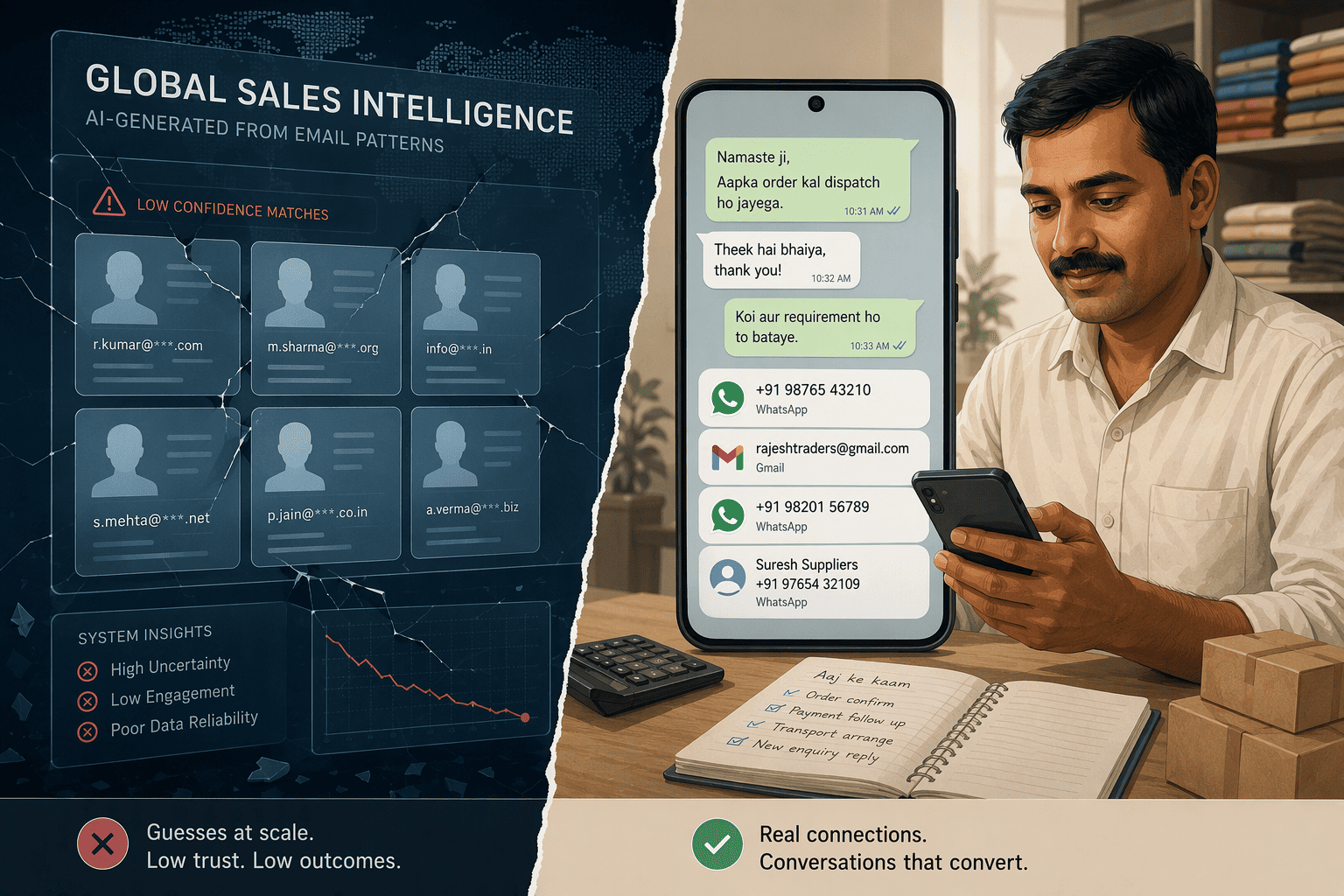
Global sales intelligence platforms are built on a single assumption that breaks down catastrophically in India: that professionals use corporate email as their primary business identifier. Instead, Indian business runs on WhatsApp and mobile phones. A massive chunk of the country's 63 million-plus MSMEs operates without a company domain, using Gmail and a smartphone. When a tool tries to guess an email by pattern-matching a name against a domain that does not exist, it creates phantom contacts. Users report that Apollo.io's automated guessing on Indian lists triggers 30 to 40% bounce rates, torching sender reputation within a single campaign.
LinkedIn scraping, the backbone of many global tools, amplifies this failure. Scrapers extract whatever a user voluntarily posted, which is often outdated the moment someone changes jobs. India's SME sector sees high turnover and contact decay, turning a six-month-old scraped profile into a guaranteed bounce. Without cross-referencing a live GSTIN or Udyam registration number, these platforms are flying blind in a market with no single centralized business registry. The result is a database that looks deep but performs like a sieve in India.
India-Optimized Verification: Methods That Actually Work
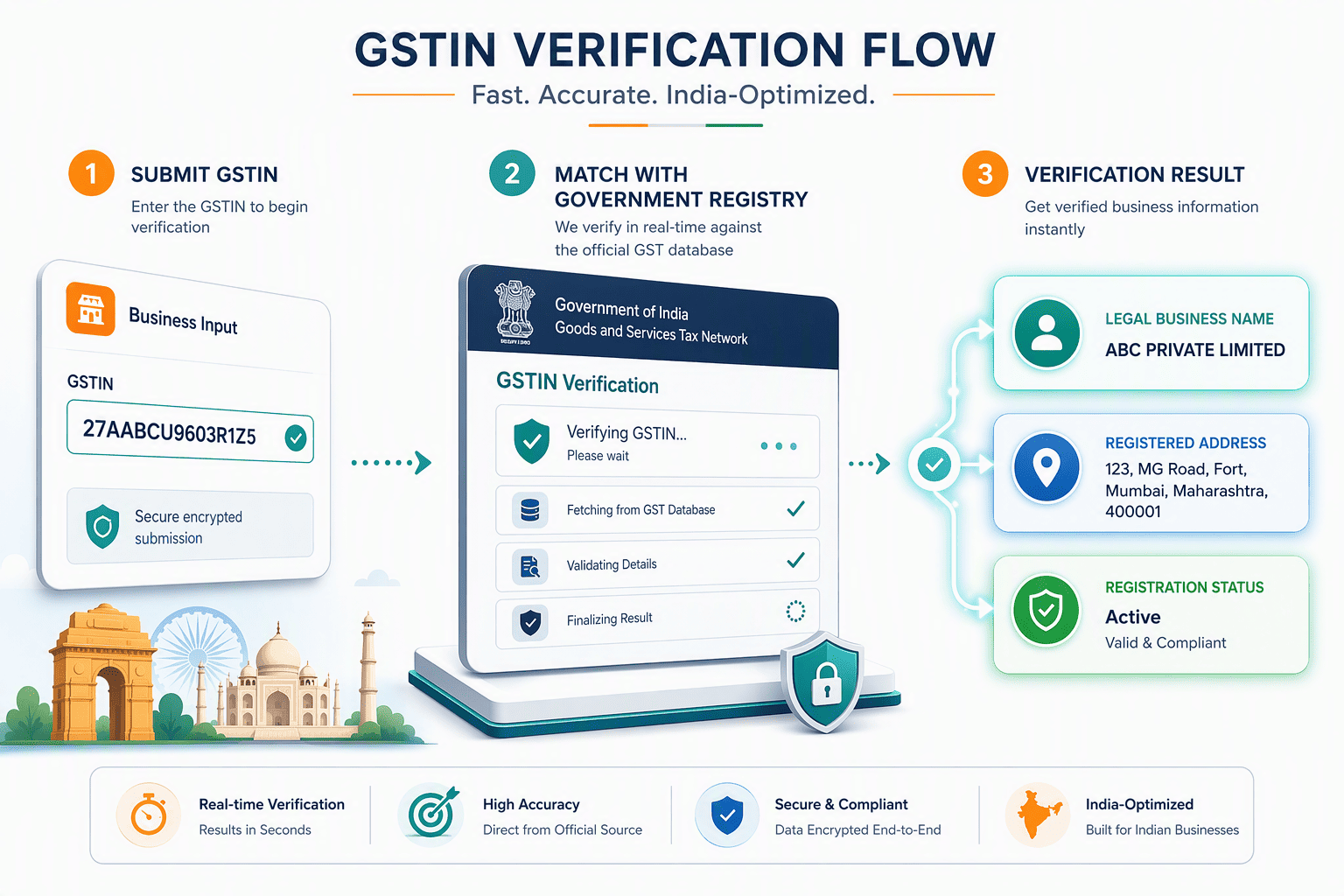
Closing the accuracy gap in India means dropping email guessing and building a verification stack on the country's own digital infrastructure. Start with three methods:
- GSTIN cross-referencing: A tool captures a company's GST number and checks it against the GST portal, pulling back the legal business name, address, and registration status in real time. India's GST network covers most B2B transactions, so this one step clears ghost companies and defunct registrations from your list fast.
- Udyam registration validation: It confirms an Udyog Aadhaar number, matching a small supplier or manufacturer's identity against the MSME database to verify they are real and active. A verified Udyam entry also flags the business vintage and classification, which helps you spot shell entities that register but never produce anything.
- Phone-to-name matching against Aadhaar-linked mobile numbers: India has over 1.2 billion Aadhaar enrollments with linked phone numbers on record (Unique Identification Authority of India, 2023 data). When a sales rep dials a number and the tool returns a name match, you know the person answering the phone is who they claim to be. Combined, these three methods turn a contact list from a liability into something a sales team can actually use.
Head-to-Head: How PeakAi, Lusha, Apollo.io, and SignalHire Compare on Indian Data
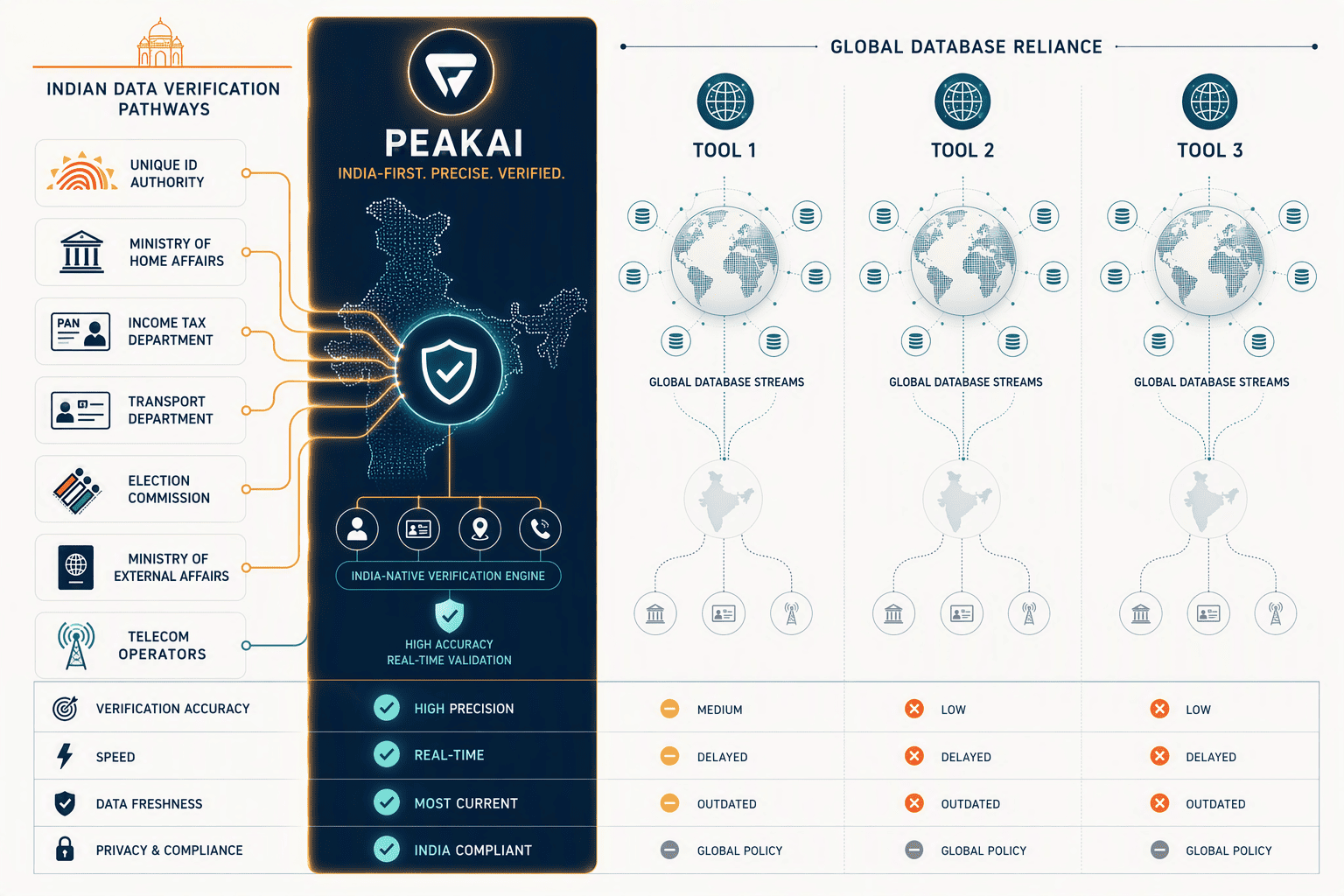
You can break these tools into two camps: those that verify against Indian registries and those that project a global database onto India's market. PeakAi is built specifically for this gap. It does not stop at scraping LinkedIn; it queries external sources like GSTIN, MCA records, and telecom databases to perform dual verification on both emails and phone numbers before download.
This approach achieves a claimed sub-5% bounce rate. In contrast, Apollo.io applies a volume-first model. Its pattern-matching engine struggles with Indian domains, generating the 30 to 40% bounce rates that kill campaigns. While Apollo gives you thousands of credits, the effective cost per accurate Indian contact is far higher.
Lusha and SignalHire sit in a middle grey zone. Lusha operates on a credit system at $0.18 to $0.35 per contact but does not focus on Indian public registries. Its data quality is stronger for US and European contacts, where corporate email adoption is standardized. SignalHire offers 10 free monthly credits for business accounts, making it a low-risk starting point, but its sourcing is heavily LinkedIn-dependent without the government registry cross-referencing needed for Indian accuracy. The core trade-off is transparent government-backed verification versus volume-based scraping.
The IT Act and DPDP Act: Navigating India's Compliance Minefield
The regulatory risk in India has shifted from theoretical to urgent. Do not evaluate a tool on price before you clear these compliance checkpoints:
- Check for proxy scraping: If the tool enriches contacts by scraping live LinkedIn profile fields without user consent, it violates LinkedIn's terms and India's IT Act 2000, which prohibits unauthorized access to computer resources.
- Demand explicit consent trails: Under the DPDP Act 2023, using scraped personal data for sales without a defined consent notice is unlawful. Your tool must source data from public directories or consent-based databases, not covert extraction.
- Audit the data provenance: Request a record from your vendor. Tools sourcing from government registries (MCA, GSTIN) maintain a transparent chain of custody. Scraping-based tools cannot provide this.
- Separate enrichment from LinkedIn: Enrichment-based tools query third-party databases using a public LinkedIn URL as a search key, avoiding direct extraction from the platform. This distinction keeps you off the radar of LinkedIn's suspension algorithms.
- Look for compliance artifacts: Check if exports include a compliance timestamp and data-source attribution. If a vendor cannot attach a source to a contact, assume it was scraped.
Pricing Decoded: Pay-Per-Contact vs. Subscription Traps
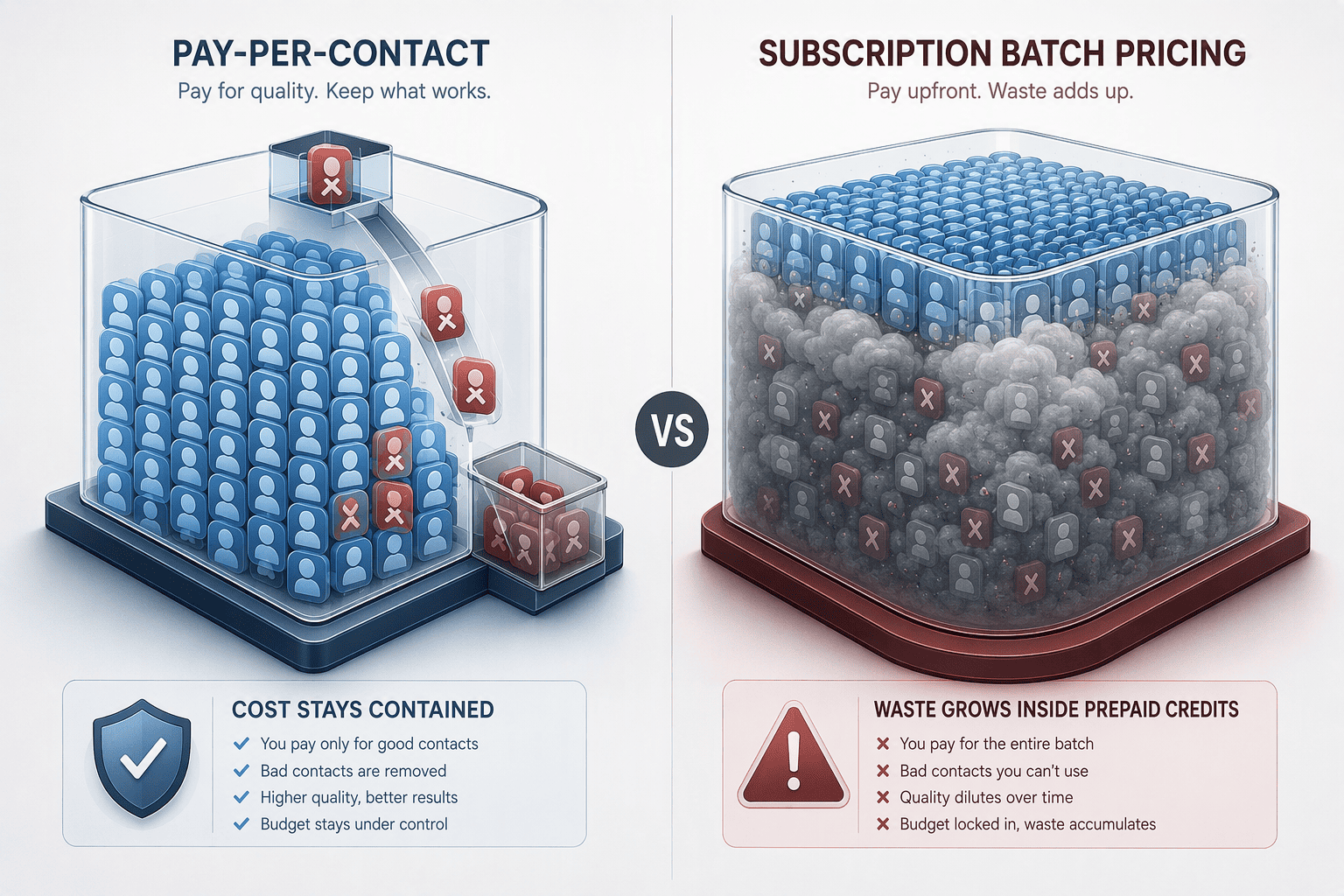
The pricing model you choose directly determines whether India's data accuracy gap becomes a manageable line item or a hidden multiplier draining your budget.
| Cost Dimension | Pay-Per-Contact | Subscription / Credit-Batch |
|---|---|---|
| Accuracy risk visibility | Each bad contact costs you a discrete, traceable amount you can reject. | Inaccurate contacts are pre-paid and buried inside a bulk allocation you cannot claw back. |
| Bad-data cost multiplier | You halt spend the moment quality dips by pausing the tap. | A 40% bounce rate means nearly half your subscription fee bought zero value, with no refund trigger. |
| Vendor incentive alignment | Vendor is incentivized to supply only contacts that pass your validation, since rejected data eats their margin. | Vendor is incentivized to fill your quota fast, even with stale or unverified records. |
| Budget predictability | Variable cost that scales directly with qualified leads; harder to forecast but easier to justify. | Fixed recurring cost; appears predictable until you measure the effective cost per valid contact. |
| Scalability in India | Safest way to test regional data quality without a long-term lock-in. | Lock-in amplifies the impact of India's 30 to 45 percent inaccuracy rate across the entire contract term. |
The 50-Contact Litmus Test: How to Validate Accuracy Before You Buy
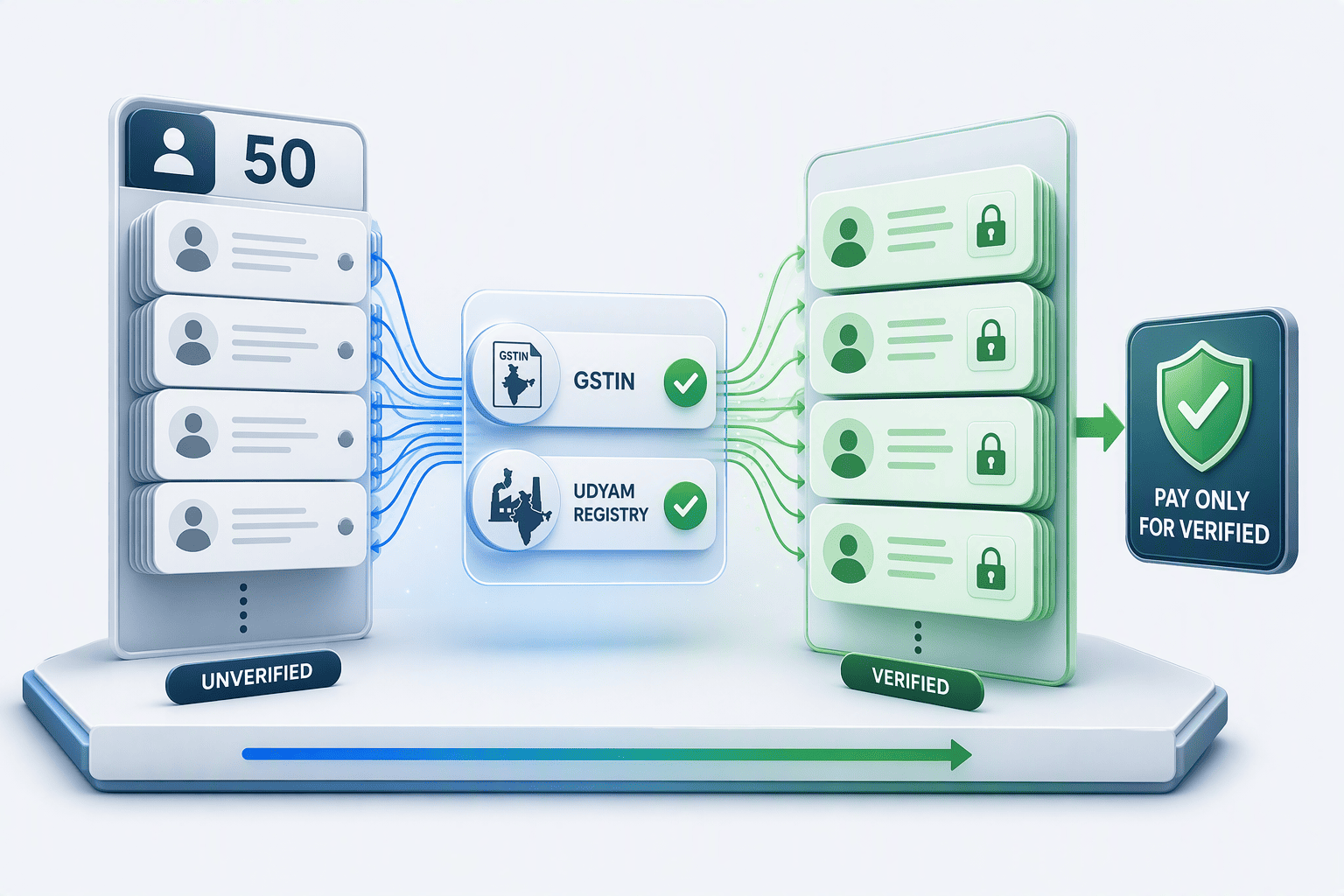
Securing an accurate B2B pipeline in India comes down to three things: verification against local registries, DPDP-compliant data sourcing, and pricing that does not charge you for bounced contacts. Global tools routinely miss the first two and flunk the third.
Run a 50-contact test on an India-optimized platform that validates against GSTIN and Udyam. Pay only for verified contacts, and you stop burning budget on phantom leads while keeping your team compliant and your inbox off the spam blacklist.
Conclusion
Accuracy in Indian B2B sales intelligence is not a feature list competition. It is a verification problem.
Tools that rely on global databases and LinkedIn scraping without local validation consistently deliver email bounce rates of 30 to 40% on Indian domains.
A tool built on GSTIN cross-referencing, Udyam registry checks, and dual phone-and-email verification changes the math entirely. You stop paying for dead data and start paying only for contacts that connect.
The difference shows up fast. Teams can build targeted prospect lists in minutes instead of hours when the underlying data is clean.
No single tool answers every use case. For multinational enterprise intelligence, platforms like ZoomInfo or D&B Hoovers carry depth that India-first tools do not yet match.
What matters is running your own controlled test on 50 to 100 known Indian contacts before committing budget anywhere. Measure what actually delivers: email deliverability, phone connectivity, and title accuracy on the people you need to reach. That one test tells you more than every advertised accuracy percentage combined.
Frequently Asked Questions
What makes a sales intelligence tool accurate for the Indian B2B market specifically, compared to global alternatives?
Accuracy in India depends on verifying contacts against local government registries like GSTIN and Udyam instead of guessing email patterns. Global tools that scrape LinkedIn or match corporate email formats see high failure rates because many Indian businesses use mobile phones and Gmail. Localized verification cross-references tax IDs and mobile OTP data to confirm a contact is real and current.
Which sales intelligence tools offer India-optimized verification, and how do their methods differ?
India-optimized tools like PeakAi query GSTIN records, Ministry of Corporate Affairs filings, and telecom databases to validate contacts before delivery. This differs from global tools like Lusha or Apollo.io, which primarily rely on LinkedIn profile scraping and email pattern generation. Government registry verification produces lower bounce rates for Indian domains, while scraping often returns outdated data.
How does PeakAi's Indian-market approach compare with tools like Lusha, Apollo.io, and SignalHire for contact accuracy in India?
PeakAi is built to cross-reference Indian public registries and perform dual email and phone verification, resulting in a claimed sub-5% bounce rate. Apollo.io and SignalHire generate higher bounce rates, with users reporting 30 to 40% on Indian lists, because they rely more heavily on pattern-matching and LinkedIn-only data. Lusha offers good global data but lacks the GSTIN-layer verification critical for Indian prospects.
What are the compliance risks with real-time LinkedIn-based enrichment tools in India, and how should buyers evaluate them?
Real-time scraping that extracts LinkedIn profile fields without consent violates platform terms and India's IT Act 2000, potentially triggering legal action and account suspension. The DPDP Act 2023 also requires explicit consent for personal data use. Buyers should evaluate whether a tool sources data from public directories or covert scrapers, and request a source attribution report for each contact.
What pricing models exist for India-focused sales intelligence tools, and how do pay-per-verified-contact plans compare?
Pricing models for Indian B2B sales intelligence tools vary widely:
- Pay-per-verified-contact: PeakAi starts at $9 for 50 verified contacts; this reduces waste for Indian teams because you pay only for confirmed records.
- Subscription credits: Apollo.io at $49/month charges credits even for low-accuracy matches that bounce.
- Per-credit tiers: Lusha at $0.18 to $0.35 per credit similarly charges regardless of whether a contact delivers.
How should Indian B2B teams test and verify a tool's contact accuracy before purchasing?
Run a 50-contact litmus test using known Indian contacts like colleagues, existing clients, and verified prospects. Measure email deliverability, phone connectivity, and job title accuracy. A tool must hit 95% email accuracy and 80% phone connection on known records to pass. Reject any vendor that refuses to let you validate with your own list before contract.
Sources
- B2B Sales Intelligence Tools: The Honest 2026 Buyer's Guide - Convo - www.itsconvo.com
- 20 best sales prospecting tools for lead generation in 2026 - monday.com
